Standardized Box Architecture & Folding Kinematics
Standardized corrugated geometry eliminates production rework, guarantees seamless flexo-folder-gluer operation, and maximizes pallet cube utilization. Frimex engineers box layouts according to standardized international structural code families.
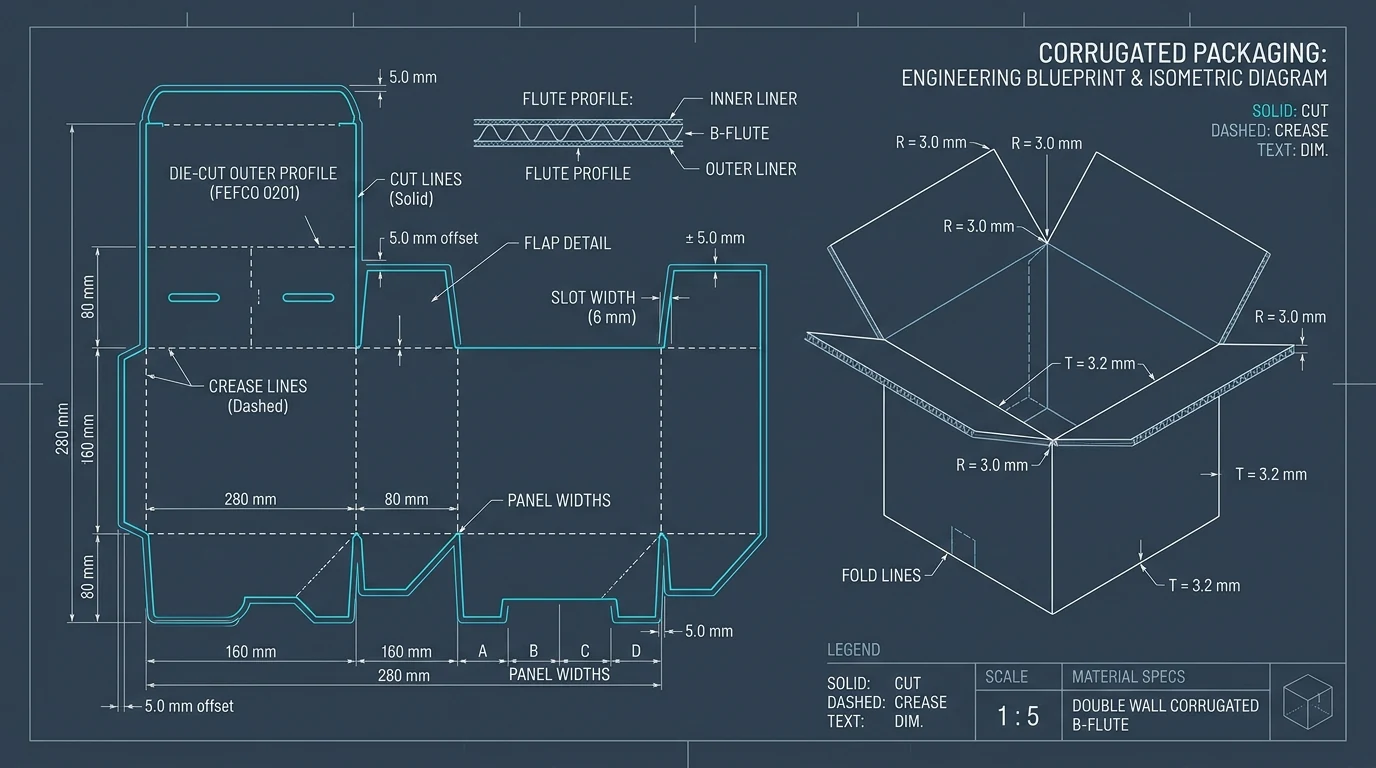
Die-Cut Precision & Crease Tolerances
Every fold line, crease allowance, and slot depth is calculated using board caliper multipliers (K-factors). Proper clearance ensures that high-speed automated erectors operate at 18,000+ units/hour without flap jamming.
- Crease Rule Depth: Calibrated to avoid liner surface fracture while enabling 180° folding flexibility.
- Slot Width Standard: Precision 6.0 mm ± 0.5 mm clearances for single and double wall configurations.
- Automated Feeder Alignment: Standardized lead-edge trim for zero skew on folder-gluers.
Regular Slotted Container (RSC) & Overlap Cases
The global benchmark for shipping efficiency. Fabricated from a single sheet with glued or stitched manufacturer's joint. Outer flaps meet precisely at the center for rapid automated taping lines.
Telescopic Lid and Base Containers
Consisting of two separate pieces (a separate lid sliding over a base tray). Offers double-thickness sidewalls that exponentially increase vertical stacking compression and resist bulging in cold storage.
Die-Cut Wrap-Around Folders & Mailer Trays
Single-piece die-cut blanks featuring self-locking front flaps and side rollover walls. No tape required for closure when fitted with peel-and-seal adhesive strips.
Auto-Lock Crash-Bottom Fast-Erect Boxes
Pre-glued multi-point cartons that pop into a rigid, fully formed box in under one second simply by pushing diagonally on opposite corners, boosting fulfillment speed by 400%.
Partitions, Dividers & Structural Corner Pads
Interlocking corrugated dividers and solid-board slotted partitions that isolate fragile bottles, jars, and machined components while reinforcing vertical box corners against crush forces.
Flexographic Converting, Die-Cutting Kinematics & Line Tolerances
Converting corrugated sheets into high-performance packaging requires sub-millimeter registration across multi-color flexo printing units, precision creasing rules, and high-speed rotary die-cut anvils operating at up to 20,000 feeds per hour.
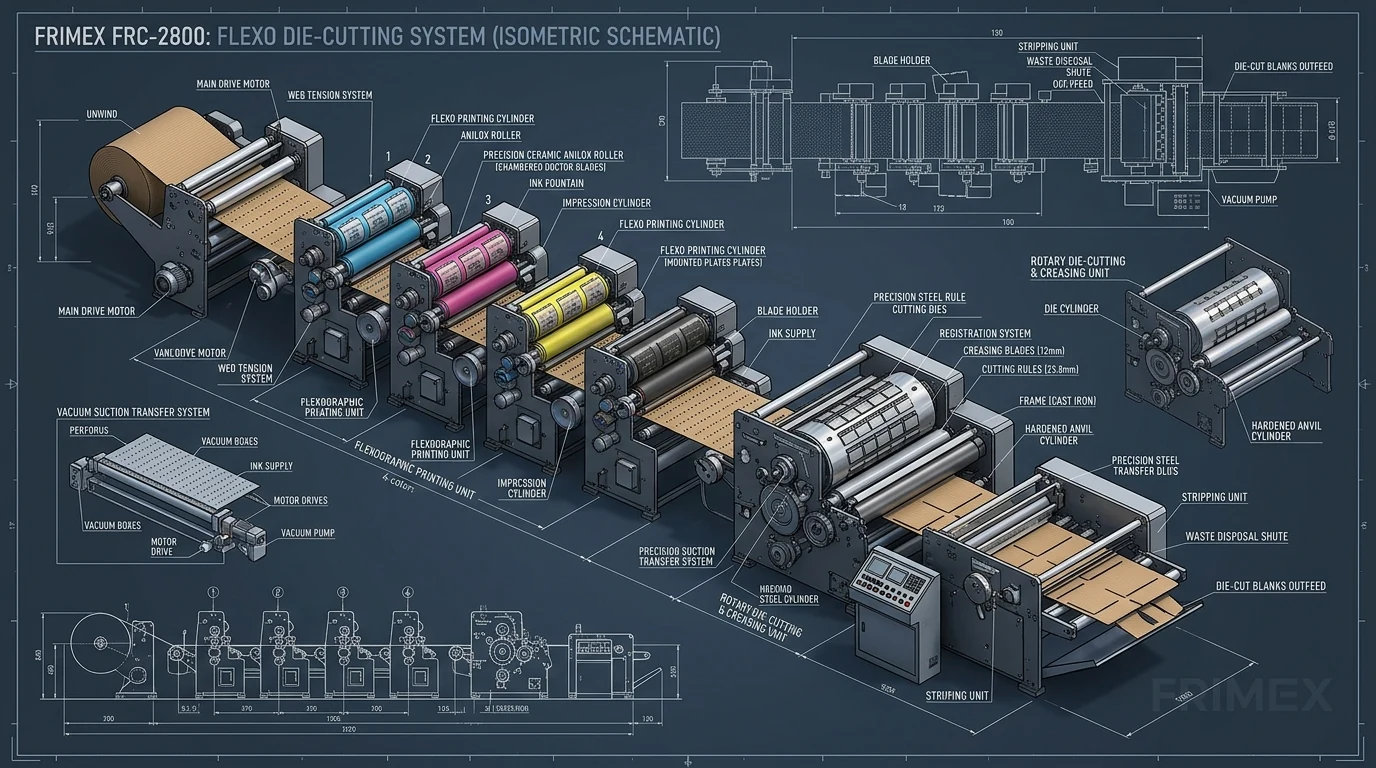
Anilox Metering & Flexo Ink Transfer
High-definition flexographic printing relies on laser-engraved ceramic anilox rolls paired with enclosed chambered doctor blade systems. Controlled cell volume (BCM) ensures uniform ink film transfer onto porous kraft liners without dot gain or flute washboarding.
- Registration Tolerance: Multi-color print registration held within ±0.25 mm across lead-edge vacuum transport systems.
- Rotary Anvil Synchronization: Micro-oscillating urethane anvil covers equalize wear, extending rule sharpness and preventing ragged cut edges.
- Ejection Rubber Durometer: Calibrated 35–50 Shore A profile rubber prevents liner scuffing during 300 m/min rotary stripping.
| Print Process Level | Anilox Screen (LPI) | Cell Volume (BCM) | Registration Accuracy | Min Dot Resolution | Optimal Substrate |
|---|---|---|---|---|---|
| Solid Flood / Background | 180 – 250 LPI | 8.0 – 10.5 BCM | ± 0.50 mm | N/A (Solid Area) | Natural Kraftliner, Recycled Testliner |
| Line Work & Barcode Standard | 300 – 450 LPI | 4.5 – 6.5 BCM | ± 0.35 mm | 10% @ 65 LPI | Top Kraftliner, Semi-Chemical Medium |
| Process Screen CMYK | 500 – 700 LPI | 2.8 – 3.8 BCM | ± 0.25 mm | 3% – 5% @ 110 LPI | White Top Kraft, Clay-Coated Liner |
| HD Flexo / Fine Graphics | 800 – 1000 LPI | 1.8 – 2.5 BCM | ± 0.15 mm | 1% Micro-dot @ 150 LPI | Ultra-Smooth Coated White Liner |
Palletization Geometry, Stacking Stability & Transit Physics
Supply chain distribution subjects corrugated packaging to multi-axial vibration, warehouse compression fatigue, and dynamic transit stress. Proper stacking geometry and load containment prevent catastrophic structural failure while maximizing pallet cube utilization.
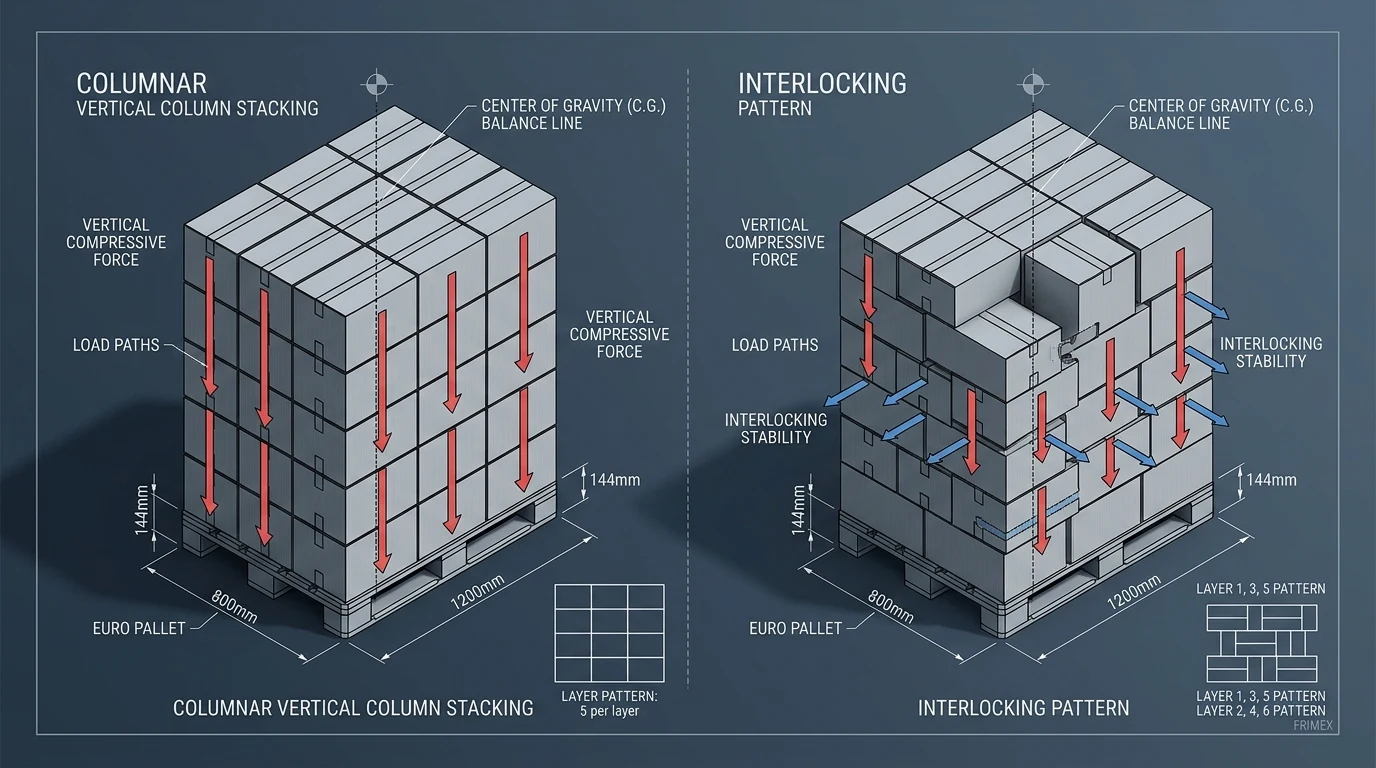
Columnar vs. Interlocking Stacking Mechanics
The four vertical corners of a corrugated box carry 60%–70% of its total top-to-bottom compressive strength (BCT). In Columnar Stacking, corners align directly over each other, preserving 100% of laboratory BCT capacity.
In contrast, Interlocking Patterns rotate boxes across layers to increase unit stability, but displace corner load paths over center flaps, causing an immediate 40% to 50% loss in total compression strength.
The Pallet Overhang Degradation Law
Overhanging corrugated cases past the edge of a wooden pallet removes rigid deck board support beneath the outer box sidewall, severely degrading vertical resistance:
Overhang Loss: 25 mm → −32% BCT Strength
Even a minor 12 mm pallet edge overhang reduces stacking capacity by 18%–22%, frequently triggering warehouse stack collapse under maritime humidity.
ASTM D4169 / ISTA 3A
Dynamic Transit TestingRandom multi-axis vibration testing (0.54 Grms) and rotational drop shock simulations that validate pallet load integrity before sea and road haulage.
Containment Force Profile
Load StabilizationPre-stretch wrapping calibrated to 250%–300% elongation, delivering 12–18 kgf containment force to lock pallet corners without crushing box edges.
Environmental Creep Factor
Long-Term StorageAccounts for corrugated viscoelastic creep deformation under 90-day warehouse loads, incorporating 1.8x to 2.4x static-to-dynamic safety multipliers.
Intermodal Cube Efficiency
Logistics DecarbonizationPrecision case dimensions tailored to 1200 × 800 mm Euro and 1200 × 1000 mm ISO pallets, achieving >94% ISO shipping container volumetric fill.
Aqueous Barrier Dispersion & Hydrophobic Surface Engineering
Traditional plastic poly-coatings (PE/wax) contaminate mill repulping systems. Frimex engineers 100% repulpable, bio-based water-dispersed barriers that seal porous kraft paper fibers against moisture vapor, vegetable oils, and industrial grease while retaining zero-plastic circularity.
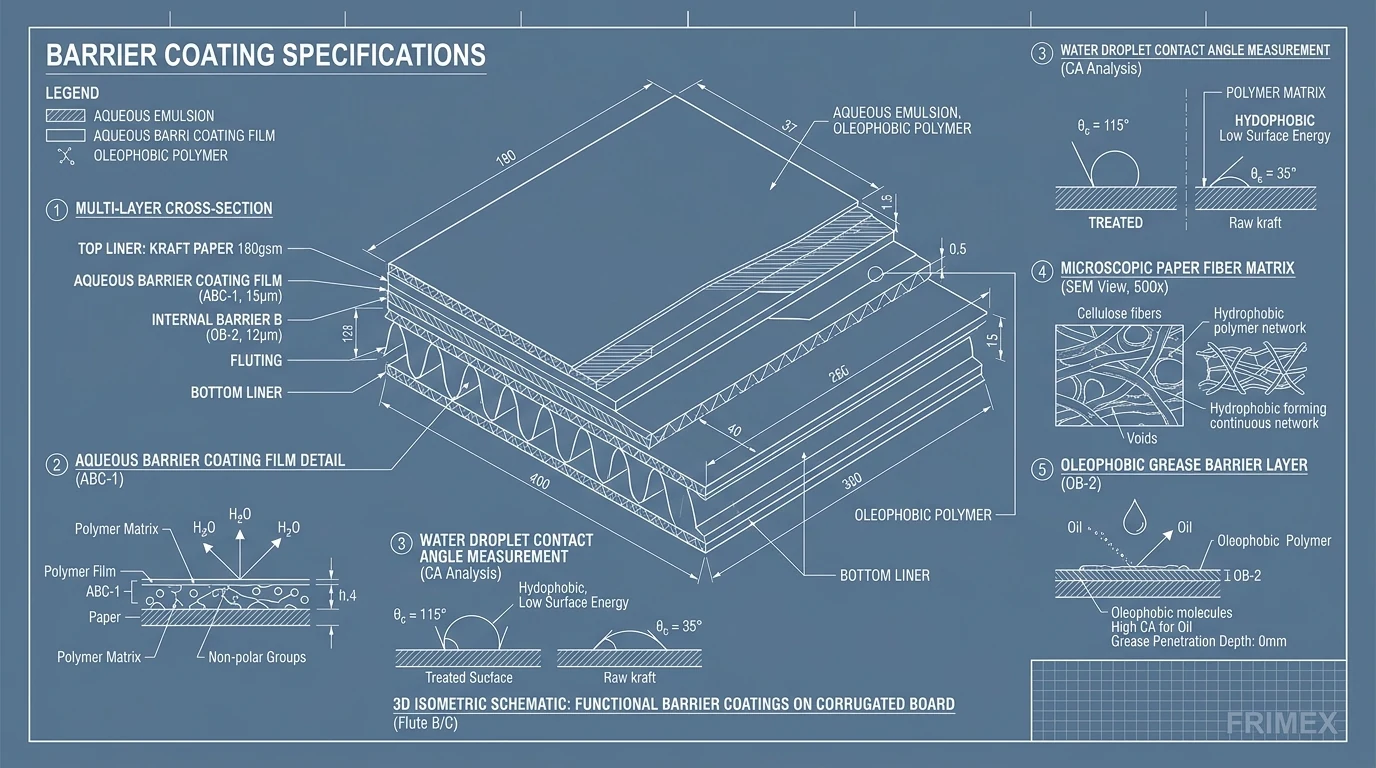
Contact Angle Dynamics & Hydrophobic Sealing
By formulating non-polar bio-polymer aqueous emulsions, the substrate surface energy is reduced below 30 mN/m, increasing water droplet contact angles (θc) from 35° (raw kraft) to over 115°. This creates a lotus-leaf beading effect that prevents moisture absorption without impeding mill fiber recovery.
- Cobb 1800 Suppression: Slashes 30-minute water absorption from 150+ g/m² down to <15 g/m² for cold-chain produce boxes.
- Oleophobic Grease Resistance: Achieves 3M KIT ratings 8–12 for oily automotive components and takeaway food containers.
- 100% Repulpable & Compostable: Compliant with EN 13432 and PTS circular repulpability testing protocols.
| Barrier Coating Formulation | Target Resistance | Cobb 60 (g/m²) | Grease KIT Rating | WVTR (g/m²/day) | Food Safety Status |
|---|---|---|---|---|---|
| Aqua-Shield Hydrophobic | Water & Humidity Repellency | < 12 g/m² | KIT 3 – 5 | < 35 | FDA / BfR Direct Contact |
| Oleoflex Grease-Lock | Hot Oils, Grease & Fats | < 25 g/m² | KIT 9 – 12 | < 50 | FDA 21 CFR 176.170 |
| Vapor-Seal Micro-Barrier | Moisture Vapor & Cold Condensation | < 8 g/m² | KIT 7 – 9 | < 15 | EU No 10/2011 Compliant |
| Bio-Seal Heat-Sealable | Ultrasonic & Thermal Flap Bonding | < 15 g/m² | KIT 8 – 10 | < 20 | 100% Plastic-Free Bio-Polymer |
Robotic Case Erecting, Hot-Melt Rheology & Line Kinematics
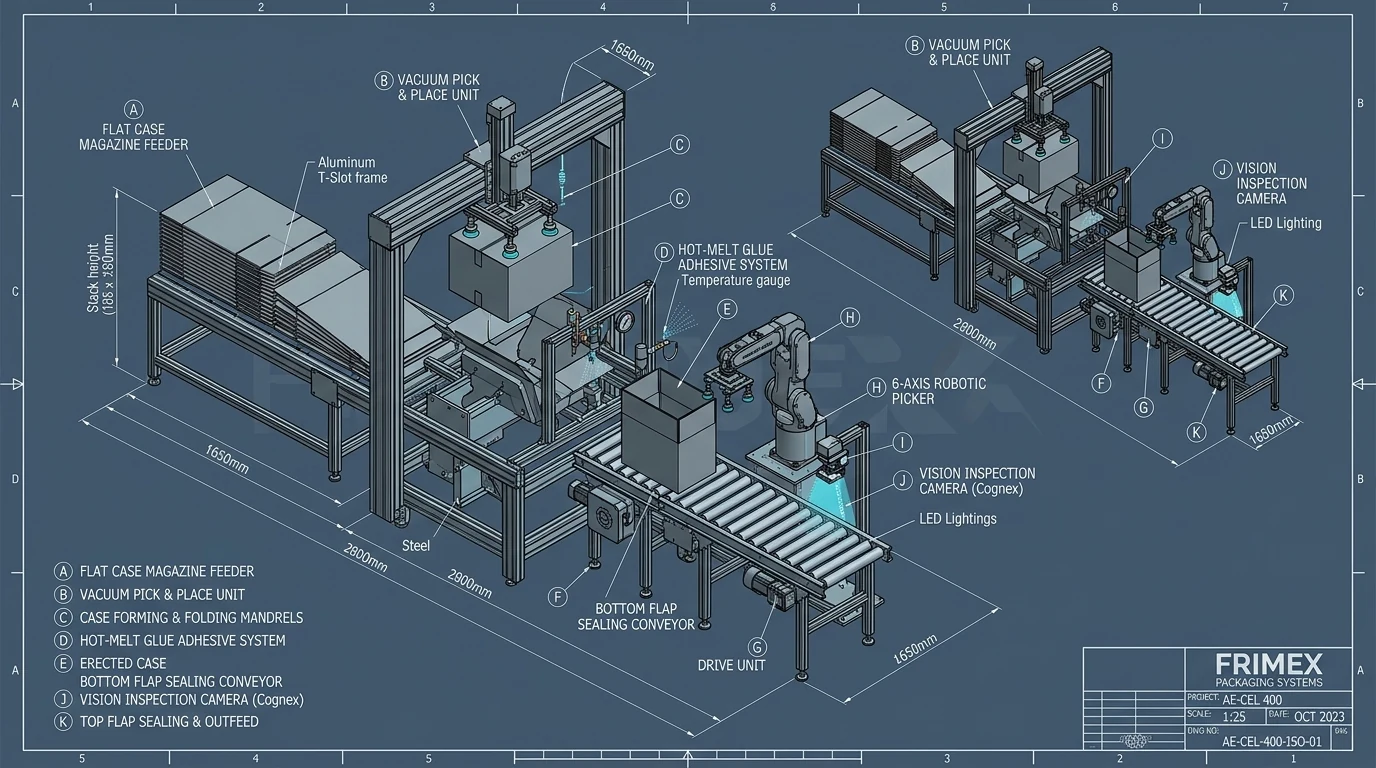
High-speed omnichannel fulfillment relies on automated robotic case erectors and top-loaders operating up to 45 cases per minute. Frimex engineers box score allowances, glue tab tolerances, and board flatnesses to ensure zero feed jamming and instantaneous hot-melt fiber-tear bonding.
Hot-Melt Adhesive Open Time & Compression Dwell
In automated case sealers, hot-melt EVA or metallocene adhesives are dispensed at 160°C–175°C. The adhesive open time (1.5–2.5 seconds) must precisely synchronize with mechanical folding mandrels, followed by a minimum 0.8-second compression dwell to ensure 100% fiber tear bond strength.
- Suction Cup Vacuum Dynamics: High-flow venturi vacuum generators calibrated to −85 kPa ensure slip-free blank separation from feed magazines.
- Flap Skew Tolerance: Robotic mandrels maintain squareness within ±0.8 mm across opposite diagonals, preventing downstream palletizing misalignment.
- Machine Vision Verification: Inline high-resolution Cognex vision cameras inspect flap closure and verify 100% barcode grade A compliance.
45 Cases / Min Speed
High-Speed KinematicsOptimized blank score elasticity ensures rapid box opening without flap rebound or mechanical stalling at high cycle speeds.
Hot-Melt Fiber Tear
Adhesion ProtocolImmediate substrate fiber pull validation under ASTM D1974 standards, ensuring tamper-evident box closure during transit.
Magazine Jam Prevention
Sheet Caliper QualityControlled board warp within <1.5 mm/m ensures flawless gravity and powered belt feeder engagement from raw bundles.
Robotic Delta Integration
Automation BenchmarkStandardized flange and flap clearance profiles allowing 6-axis articulated and delta pick-and-place end effectors rapid entry.
Closed-Loop Recyclability & Export Compliance
Corrugated cardboard represents the gold standard of circular packaging: 100% bio-based, renewable, and infinitely recyclable. Frimex assists mills and converters in aligning with European PPWR and international eco-regulations.

EU PPWR & Closed-Loop Recycling Principles
With stringent global packaging legislation coming into effect (such as the European Packaging and Packaging Waste Regulation), brands and exporters must design for complete recyclability.
- Design for Recyclability (DfR): Water-based non-toxic flexo inks and dispersible starch adhesives that separate cleanly during repulping.
- Right-Sizing & "Anti-Void" Engineering: Eliminating excess interior air space to reduce corrugated consumption by up to 22% and maximize container loading.
- Plastic Void Replacement: Replacing plastic bubble wrap and EPS foam with 100% paper-based expanding accordion buffers.
>89% Global Fiber Recovery
Circularity BenchmarkCorrugated fiber can be recycled up to 25 times without catastrophic structural breakdown when blended with high-yield virgin kraftliner top sheets.
GMP Hygiene Compliance
Food Safety ProtocolGood Manufacturing Practice standards for food-contact board: non-migrating barriers, micro-biological clean rooms, and dust-free production.
Transport Cube Maximization
Decarbonization MetricStandardized sizing allows up to 18% more finished cases per Euro/ISO pallet, directly reducing per-unit freight CO2 emissions.
Corrugated Flute Physics & Performance Matrix
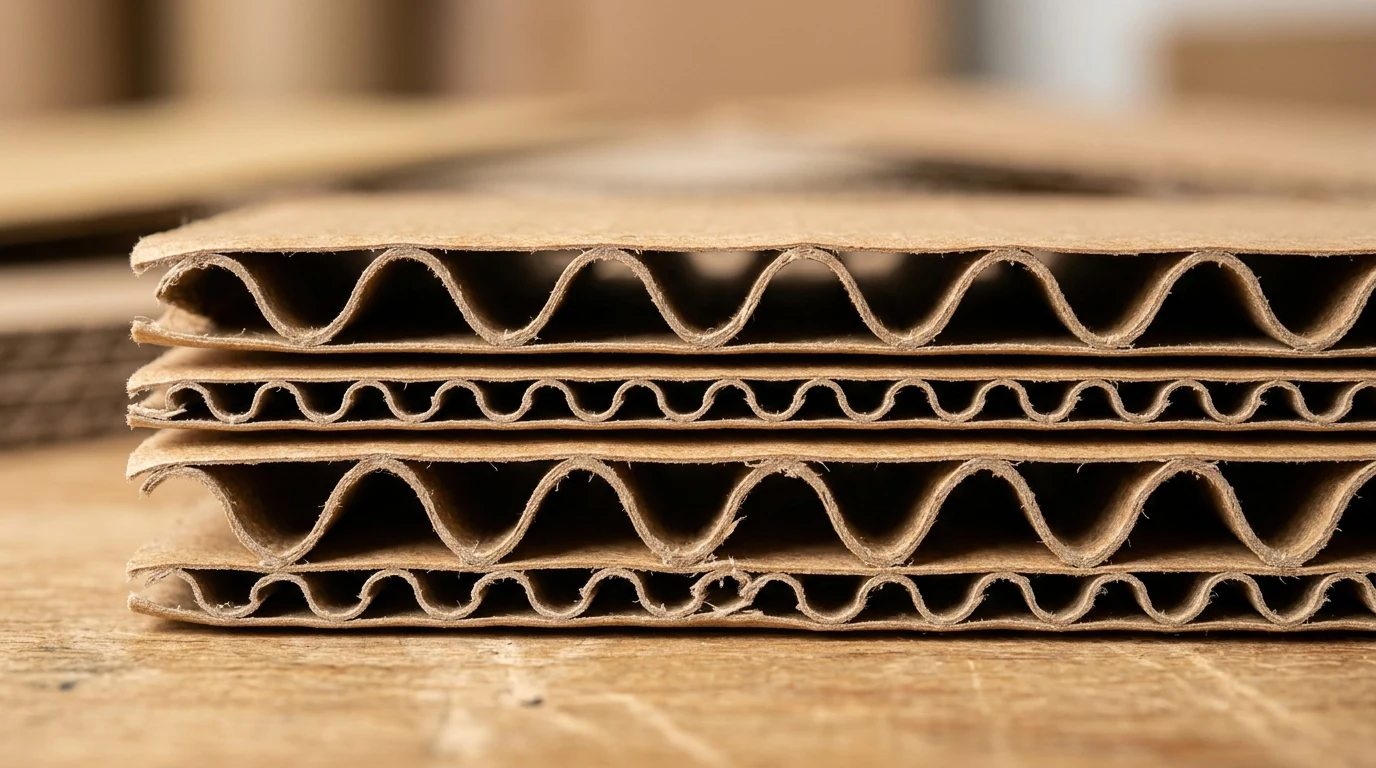
Fluting geometry determines the structural balance between vertical load-bearing capacity (ECT) and print surface smoothness. Frimex provides precision flute profile configuration to optimize raw material grammage.
The Mechanics of the Corrugated Arch
Just like architectural arch bridges, corrugated flutes resist bending and vertical crushing by transferring load across wave crests. Frimex evaluates corrugator roll profiles to ensure zero flute crush during feeding and printing.
- Fluting Factor (α): The take-up ratio of fluting paper per linear meter of board (typically 1.35 to 1.55).
- Caliper Uniformity: Tight tolerance control within ±0.05 mm prevents washboarding on printed liners.
- Starch Bond Integrity: Pin adhesion testing ensures zero delamination under transit vibration.
| Flute Profile | Caliper (Height) | Flutes per Meter | Take-Up Ratio | Stacking Rigidity (ECT) | Print Surface Finish | Optimal Application |
|---|---|---|---|---|---|---|
| A - Flute | 4.5 – 5.0 mm | 105 – 125 | ~1.54 | High Compression | Coarse (Cushion-heavy) | Heavy industrial, fragile cushioning |
| C - Flute | 3.5 – 4.0 mm | 120 – 145 | ~1.43 | Strong Vertical Load | Medium Flexo Standard | Global shipping RSC cases, FMCG master shippers |
| B - Flute | 2.5 – 3.0 mm | 150 – 170 | ~1.32 | High Flat Crush (FCT) | Good Flexo Resolution | Canned goods, die-cut trays, shelf-ready packaging |
| E - Flute (Micro) | 1.1 – 1.6 mm | 290 – 320 | ~1.25 | Moderate Load | Excellent Litho/HD Flexo | Cosmetics, consumer electronics, e-commerce mailers |
| F - Flute (Nano) | 0.75 – 0.9 mm | 410 – 430 | ~1.18 | Low Load | Ultra-Smooth Offset | Direct folding carton replacement, luxury retail |
| BC - Double Wall | 6.0 – 7.0 mm | Combined (B+C) | ~1.38 | Heavy Freight Rigidity | Dual-Layer Protection | Export master containers, heavy machinery parts |
| EB - Double Wall | 4.0 – 4.8 mm | Combined (E+B) | ~1.29 | High Strength + Fine Print | Flawless Graphics Outer | Premium retail displays, high-end export cartons |
Physical Strength Verification & Compression Physics
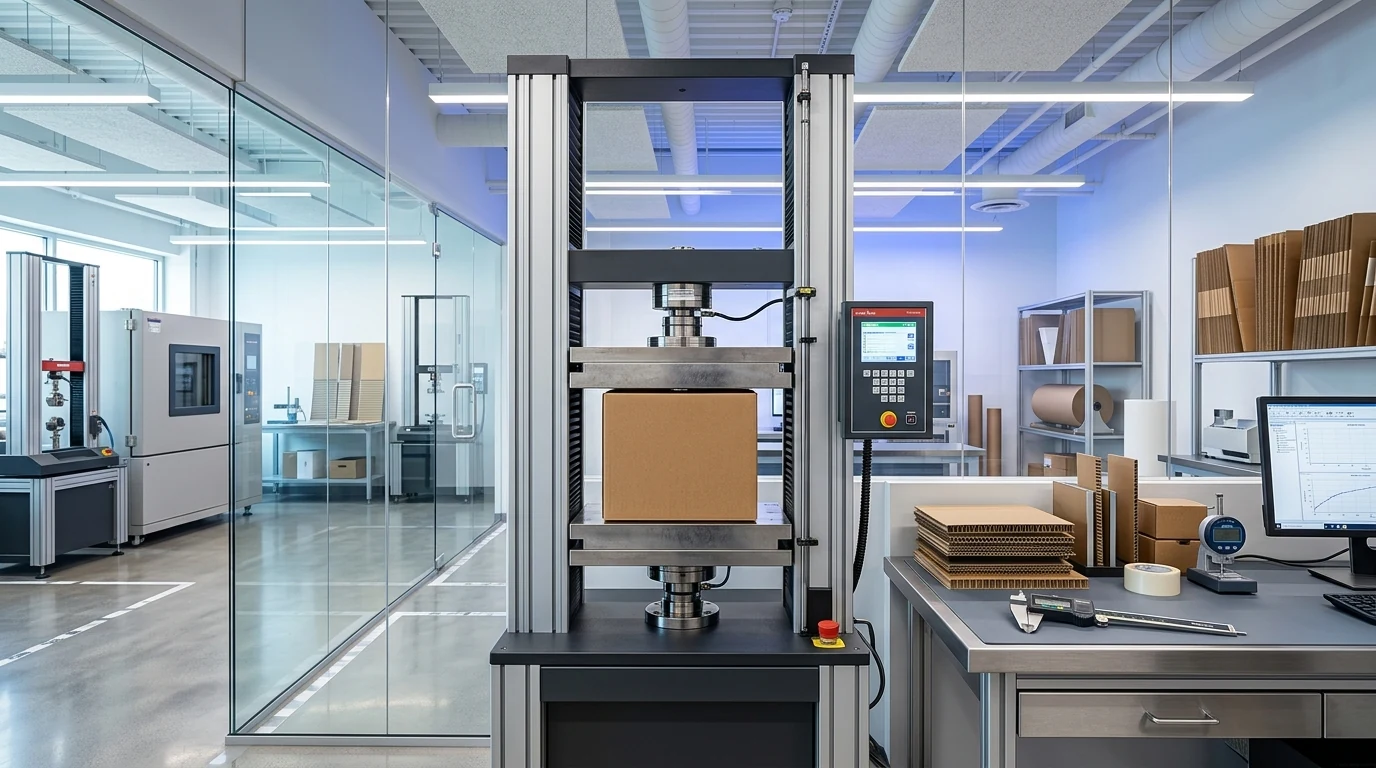
Never guess your packaging strength. Frimex utilizes established physical testing standards across accredited partner laboratories to calculate precise safety factors, preventing pallet collapses while eliminating costly over-packaging.
The McKee BCT Stacking Formula
Box Compression Test (BCT) estimates the ultimate vertical load a finished box can withstand before sidewalls buckle. Frimex applies the McKee equation:
BCT = 5.87 × ECT × √(h × Z)
Where ECT is the edge crush resistance (kN/m), h is the board thickness (mm), and Z is the box perimeter (2L + 2W in mm).
- Dynamic Safety Factor (SF): Calculating humidity degradation (up to 50% loss at 85% RH), storage duration, and pallet overhang factors.
- Grammage Optimization: Reducing liner basis weight by 10-15% while sustaining required dynamic stacking thresholds.
Edge Crush Test (ECT)
ISO 3037 / TAPPI T 811Measures the edgewise compressive strength of corrugated board. The primary benchmark for calculating vertical pallet stacking durability.
Cobb Water Absorption
ISO 535 (Cobb 60 / Cobb 1800)Measures the quantity of water absorbed by paperboard in a specified time (g/m²). Crucial for fresh agricultural produce and maritime export.
Bursting Strength (Mullen)
ISO 2759Quantifies the hydrostatic pressure required to rupture a corrugated sheet, validating puncture security for heavy bulk commodities.
Flat Crush Test (FCT)
ISO 3035Evaluates flute resistance under perpendicular pressure, ensuring fluting does not collapse under high-speed printing cylinder nip.
Request a Technical Packaging Audit
Collaborate with Frimex structural packaging engineers to benchmark your ECT/BCT stacking safety margins, optimize corrugator fluting profiles, or achieve full global and European PPWR circularity compliance.